
Product
Pre-admission and risk assessments for care homes
Decide whether you can meet someone's needs, then keep their falls, pressure, bed rail and evacuation risks reviewed on time.
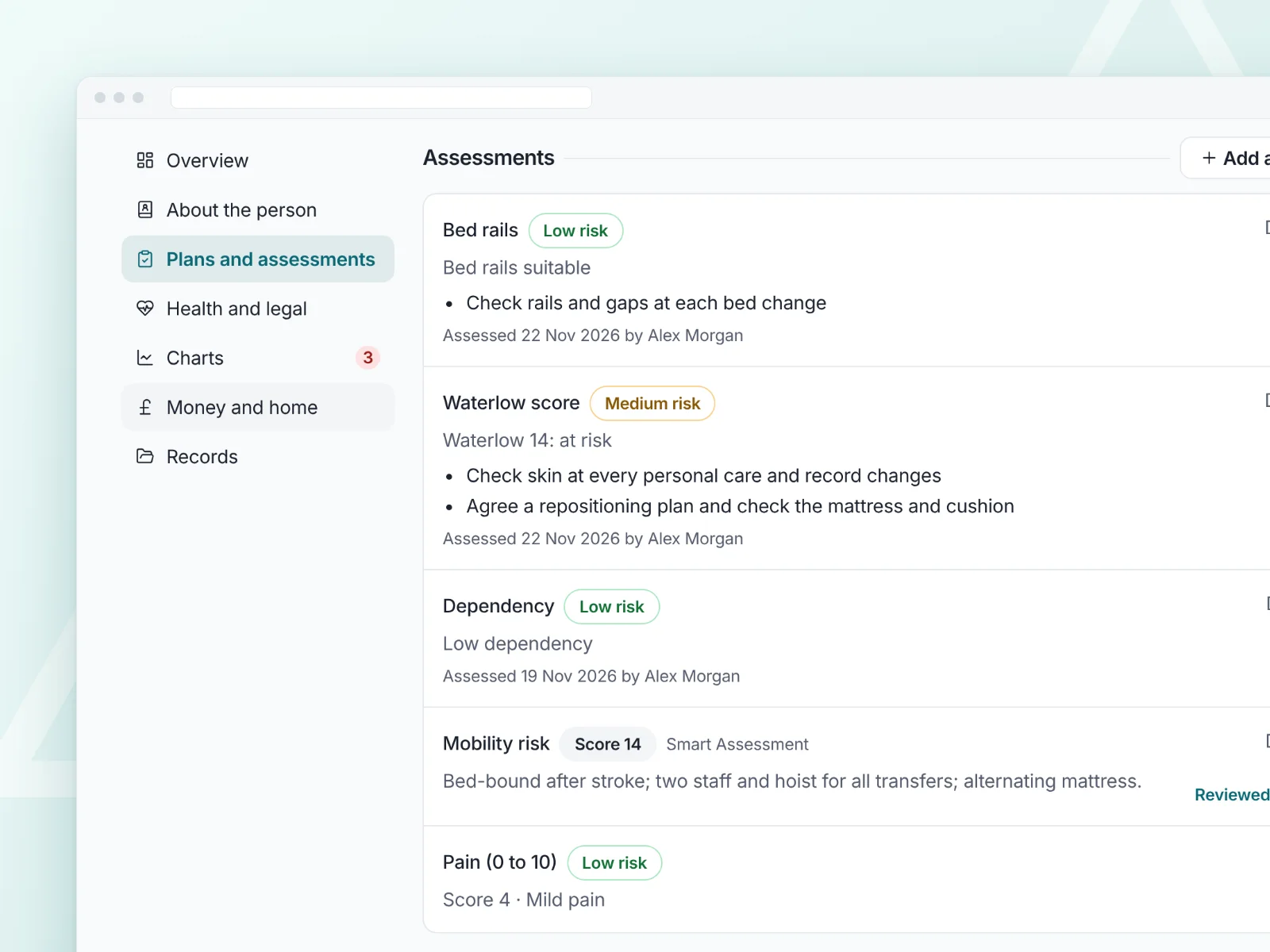
An assessment is only useful if it changes what happens next. Aiderra's pre-admission assessment will not take a decision until the parts a decision rests on are recorded, and admitting someone starts their care plan from it. Once they live with you, each resident's falls, pressure, bed rail and evacuation risks sit on their record, and a high result brings the matching part of the care plan forward for review.
Why teams choose Aiderra
A pre-admission decision you can explain
Record who the person is, their needs in each care plan area, the risks to plan for from day one, their medicines, equipment, capacity and funding. Accepting or declining is held until the essentials are in, and declining needs a reason, so you can show an inspector why you said yes or no.
Admission starts the care plan
Admitting someone creates their record and starts their care plan from the assessment, with the first review set four weeks on. Nothing is typed twice.
Falls risk the way NICE describes it
A multifactorial falls assessment: each of the person's risk factors, with the action it calls for, from a medication review to a podiatry referral. There is no points score, because NICE advises against using one to predict who will fall.
Pressure, bed rails and evacuation
Record the Waterlow total from the nurse's card against the published bands. Check bed rails against the points in MHRA guidance, including entrapment gaps and consent. Keep a personal emergency evacuation plan for everyone who would need help to leave the building.
Reassess from the last answers
Reassessing starts from the previous answers and keeps earlier results as history, so you can see how a risk has changed. Weight and pain results from the person's daily charts show alongside.
Every review date in one list
Reviews due brings together what is overdue, due in seven days and due in four weeks: care plans, risk assessments, mental capacity, consent, open wounds and DoLS renewals. Each line opens the person's record where the review is.
Features included
- Pre-admission: needs in each care plan area, risks, medicines, equipment, capacity and funding
- No decision until the essentials are recorded, and a reason needed to decline
- Admitting creates the resident and starts the care plan, with the first review in four weeks
- Falls risk: ten risk factors, each with the action it calls for
- Waterlow total recorded against the published bands (the nurse completes the official card)
- Bed rail checks drawn from MHRA guidance
- A PEEP for each resident who needs help to evacuate
- Abbey pain scale and weight results shown from the daily charts
- A high result brings the matching care plan section forward for review
- Reviews due: overdue, due in seven days and due in four weeks, for every kind of review
Frequently asked questions
Does Aiderra include the Waterlow scoring card?
No. The Waterlow card is its author's copyright, so the nurse completes the official card and records the total in Aiderra, which applies the published bands and keeps the history.
Why does the falls assessment have no score?
NICE advises against using a points score to predict who will fall. Aiderra records each risk factor the person has and the action it needs, which is the approach NICE recommends instead.
Which plan includes assessments?
Pre-admission assessments, resident risk assessments and Reviews due are on every plan, Starter included.
See Assessments in your service
Try it with your own team free for 30 days, with no card needed. Or book a 20-minute demo tailored to your setup: no slide decks, just the product.